To promote the deep integration of artificial intelligence technology with specific application scenarios in transportation, and to help young faculty members gain a thorough understanding of the university's proof-of-concept policy and the pathways for commercializing scientific and technological achievements, the Young Faculty Development Committee of the School of Transportation, in collaboration with the Proof-of-Concept Center of Southeast University, held a lunch exchange event for the "AI + Specific Application Scenarios" proof-of-concept projects on September 9 in Meeting Room 331 of the School of Transportation. Yang Xiaohui, Director of the Proof-of-Concept Center of SEU Science and Technology Park Co., Ltd., Li Dafei, Deputy Director, and Xu Jian, Service Manager, attended the event. The meeting was chaired by He Huan, Assistant Dean of the School of Transportation and Deputy Director of the Young Faculty Development and Interdisciplinary Research Committee.
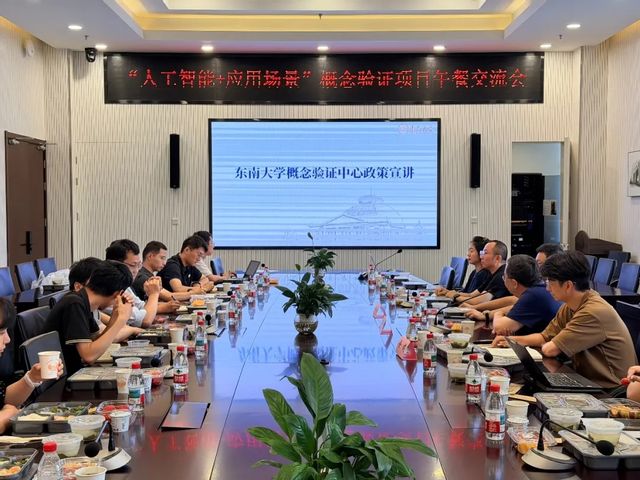
At the event, Xu Jian, Service Manager of the Proof-of-Concept Center, delivered a systematic introduction to the major challenges faced by universities in commercializing scientific and technological achievements, covering the center's establishment, service offerings, project support mechanisms, and application requirements for the AI special program. He focused on explaining how to start from real-world application scenarios and progressively move research outcomes from technology validation and prototype development toward productization and industrialization. Following the presentation, the participating faculty members, drawing on their own research directions, engaged in in-depth discussions with the center's experts on topics including the application value of projects, technical feasibility, scenario expansion, industry collaboration, intellectual property protection, and models for achieving technology transfer.
This event deepened the faculty's understanding of the proof-of-concept policy and the pathways for commercializing research achievements, helped young faculty members broaden their thinking on the transition from pure technology research to a product-oriented and market-oriented mindset, and laid a solid foundation for establishing a regular communication mechanism between the school's research teams and the university's Proof-of-Concept Center, as well as for advancing the implementation of "AI + Transportation" projects and outcomes.